Phonon Imaging Patterns
The slowness surface
defined by the Christoffel equation for bulk waves propagation in anisotropic media
exhibits many interesting features. Because of the folds on the surface, the
wave surface which defines the group velocity will have higher degree of
freedom and complex geometry. The surface geometry of the wave surface can be
either illustrated by the Gauss map of the slowness surface theoretically, or
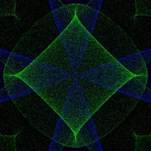
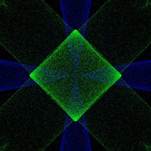
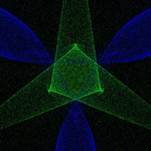
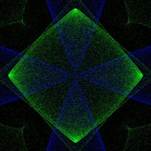
by the phonon focusing patterns experimentally in form of various sets of
caustic lines. It is well known that the each sheet of
the slowness surface can be divided in to
concave/saddle and convex regions separating be the so-called parabolic line.
The caustic lines are then simply the polar projection of the parabolic lines.
In cubic media, however,
the parabolic lines consist, in fact, of mainly inflection points on the
slowness surface. The pure parabolic region on the slowness surface can only be
found at limited points with respect to some symmetry planes. Such a parabolic
region can be characterized by its vanishing transverse curvature normal to the
symmetry planes. Some attempts have been made to identify the zero-transverse
curvature in the symmetry planes using either direct deduction or the
perturbation method the Christoffel equation. Still, the normal for the
parabolic points, which produces many characteristic points in the phonon
focusing patterns, have not been investigated analytically. The problem can
also be better illustrated in the context of the phonon focusing patterns in the cubic crystals (see linker to the right).
The main challenge here is
then not only to identify the parabolic points but also to find the surface
normal at the points and further to formulate the direction of the surface
normal explicitly. In this investigation, we will confine ourselves to parabolic
points located in the symmetry planes so that the surface normal can be
represented by the curve normal due to the symmetry. In this project, inistead of calculating the Gaussian curvature, we apply
the Stroh formalism for two-dimensional elastodynamics
to the principal symmetry planes in cubic crystals. The determination of the
parabolic points in the symmetry plane becomes identifying the socalled zero-curvature transonic states. The calculation
of the surface normal is reduced to finding the degenerate Stroh eigenvalues
within the symmetry plane, which in turn descibes the
parabolic caustic points.
It is important to realize
that the parabolic line defined on the slowness surface consists of both the
inflection points and the parabolic points. The signature along the symmetry
planes can also be dived into two types: inflection points and parabolic points.
As the inflection point results in cuspidal point on the wave surface, the
parabolic point brings about a focal point on the wave surface.
By recognizing the
connection between the parabolic points and the degeneracy in the Stroh
eigenvalue problem, we are able to obtain directions
for the parabolic points in terms of two simple functions. The approach
requires application of the Stroh formalism twice: first to resolve the zero transverse curvature transonic state and thereafter to
find the surface normal at the transonic state. Together with the previous
examination of the caustic/anticaustic points, we
have successfully resolved analytically all the characteristic points in the
phonon focusing pattern in the cubic media. The method
outlined can also be applied to crystals with other symmetries. Although these
characteristic points on the slowness surface were investigated in the context
of the phonon imaging, it is expected that the results can be readily applied
to other related field, such as determination of elastic constants, phonon
dispersion, and so on.
Some results and demonstrations:
|
Main result Total analytical delineation of the locations
of the characteristic points in the Phonon imaging patterns. |
||
|
|
||
|
Phonon focusing patterns |
|
|
|
|
|
|
|
Cuspidal points in (100) plane |
Analytical Condition f = 0 for φ1 |
Numerical result for φ1
|
|
Cuspidal points in (110) plane |
Analytical Condition g = 0 for φ2a / φ2b |
Numerical results for φ2a / φ2b |
|
|
|
|
|
Swallowtail points in (100) plane |
Analtical Condition for
φ1 |
Numerical results for
φ1 |
|
Swallowtail points in (110) plane |
Analytical Condition for φ2α |
Numerical results for φ2α |
|
|
|
|
|
Some examples |
|
|


Some PowerPoint presentations:
Caustic points in the symmetry planes of cubic crystals